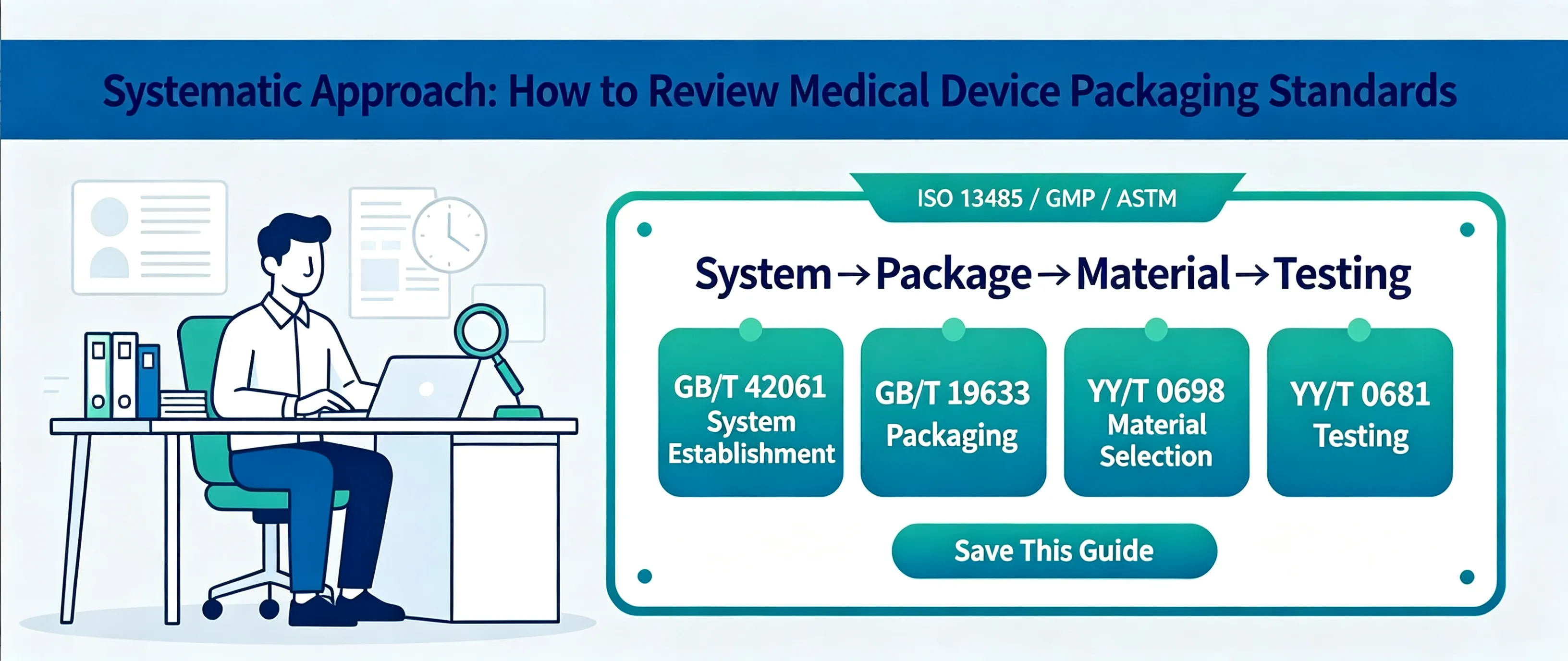
These four layers correspond to four questions: How to build the system → What are the requirements → How to select materials → How to conduct testing. Core objective: The establishment and operation of the quality management system must strictly comply with the regulatory requirements of the domestic "Good Manufacturing Practice for Medical Devices".
A new colleague recently joined our team and was overwhelmed by a bunch of standard codes—ISO 13485, GB/T42061, GB/T 19633, YY/T 0681, GMP… What are the relationships between them? Which one governs packaging? Which product should use which standard? This article will clarify everything for you.
I. Remember a few core relationships:
1. ISO 13485 = GB/T 42061
In October 2022, the national standard GB/T 42061-2022, "Medical devices—Quality management systems—Requirements for regulatory purposes," was released, equivalent to ISO 13485:2016, and will be implemented on November 1, 2023. The previously commonly used YY/T 0287-2017 has been replaced.
Say ISO 13485 and GB/T 42061 refer to the same thing.
2. Quality Management System vs. Packaging Standards
GB/T 42061 (ISO 13485): Governs how to establish the entire quality management system.
GB/T 19633 (ISO 11607): Specifically governs the requirements and inspection methods for aseptic packaging.
GMP: Governs how to manage the production site (132 clauses in the 2025 version, effective November 1, 2026).
II. Three-Tier Packaging Standard Structure
my country's terminally sterilized medical device packaging standards are divided into three tiers, totaling over 30 items:
Tier 1: Top-level general standards—GB/T 19633 series (the "constitution" of packaging)
| Standards |
What does it govern? |
| GB/T 19633.1-2024 |
Requirements for packaging materials and systems |
| GB/T 19633.2-2024 |
Validation requirements for processes such as sealing (IQ/OQ/PQ) |
Equivalent to ISO 11607-1/-2, implemented on December 1, 2025. It's indispensable for sterile medical device packaging.
Tier 2: Material Standards – YY/T 0698 Series (Packaging "Material Standards") Comprising 10 parts, specifying detailed requirements for various packaging materials:
- Blister Packaging Co-extruded Plastic Film
- Sterilization Wrapping Materials
- Paper Bags
- Paper and Plastic Film Combination Bags
- Ethylene Oxide or Radiation Sterilization Sealable Coated Paper
- Reusable Containers for Steam Sterilizers
- Polyolefin Nonwoven Fabric Materials
Tier 3: Test Method Standards – YY/T 0681 Series (Packaging "Inspection Standards") Comprising 18 parts, covering all test items:
- Accelerated Aging (ASTM F1980)
- Sealing Strength (ASTM F88)
- Microbial Barrier (ASTM F1608)
- Transport Simulation (ASTM D4169)
III. Matching by Product Type
| Product Type |
Examples |
Packaging Requirements |
| Sterile Class III |
Implants, cardiac pacemakers |
Full set of GB/T 19633 + biological evaluation |
| Sterile Class II |
Syringes, infusion sets, catheters, surgical gowns |
Full set of GB/T 19633 (three routine tests + aging + transportation) |
| Sterile Class I |
Sterile adhesive bandages, medical masks |
Simplified requirements; focus on seal integrity and microbial barrier |
| Non‑sterile Supplied Products |
Sphygmomanometers, ordinary dressings |
GB/T 19633 not mandatory; transportation verification required |
| Drug‑Device Combinations |
Prefilled syringes, drug‑eluting stents |
GB/T 19633 + pharmaceutical packaging material standards + biological evaluation |
IV. Quick Start Guide for New Colleagues
System-Related Standards
- GB/T 42061 (≈ISO 13485): Quality Management System, the core of the core
- GB/T 42062 (≈ISO 14971): Risk Management, covering the entire process
- GMP: Production Site Management Standards, new version effective November 1, 2026
Packaging-Related Standards
- GB/T 19633 (≈ISO 11607): Top-level requirements for packaging (essential for sterile instruments)
- YY/T 0698: Specific standards for various packaging materials
- YY/T 0681: Operational standards for various testing methods
- ASTM F1980: Accelerated aging program design
- ASTM D4169: Transportation simulation validation
Conclusion: Many standard codes, but the underlying logic is clear:
→ For quality management, refer to GB/T 42061
→ For sterile packaging, refer to GB/T 19633
→ Material selection follows YY/T 0698
→ Testing and verification follow YY/T 0681
These four layers correspond to four questions:
How to build the system → What are the requirements → How to select materials → How to conduct testing. Core objective: The establishment and operation of the quality management system must strictly comply with the regulatory requirements of the domestic "Good Manufacturing Practice for Medical Devices".